
The viewing is on a Saturday morning. A couple walk through the house, seem interested, and then step out into the back garden. They stand on a cracked concrete slab, look at the peeling pointing around the edges, and one of them says something quietly to the other.
The offer that follows is lower than it could have been. You’ve been told that outdoor space adds value, but you’ve also been quoted a figure for the patio you want, and you’re not sure whether you’ll see that money back. A patio can improve a property’s appeal and its value, but only if the material suits the setting, the groundwork is done properly, and the finish holds up. A cheap job that lifts in year two works against you at the point of sale.
If you’re weighing up your patio options for your home, this is what it actually comes down to.
What Buyers Look for & Why Outdoor Space Matters
A garden or patio is rarely the only reason someone buys a house, but it can be the reason they choose one property over another. Buyers want usable outdoor space, somewhere they can sit, entertain, and spend time without the ground turning to mud underfoot.
According to research by Aviva, cited in Hillarys’ 2025 home renovation statistics, more than half of UK homeowners renovate primarily to improve the appearance of their property. A tired, cracked, or poorly finished outdoor space works against that impression at every viewing [1].
Fortunately, that deterioration is fixable. A clean, well-laid patio does the opposite and this patio repointing job in Ringwood shows what a difference addressing the pointing alone can make to a tired outdoor space.
Outdoor Living Space & Buyer Expectations
Since 2020, outdoor space has featured more heavily in what buyers say they want. A patio extends the functional square footage of a house in a way that a bare garden simply doesn’t, and buyers can see that potential immediately.
Kerb Appeal & First Impressions
A property’s exterior sets expectations before anyone steps through the door. A dated or neglected front surface tells buyers something about how the rest of the property has been maintained, and that first impression is the one that earns a second look.
Does a Patio Genuinely Add Value & How Much?
According to Checkatrade’s 2025 home improvement guide, garden landscaping, including a new patio, can increase a property’s value by up to 10%, with the biggest gains reported in cities such as London [2].
However, no uplift is guaranteed. The figure depends on the property, the local market, and the quality of the finished result.
The material you choose plays a significant part in this. Three options come up most often for Dorset properties:
- Porcelain offers a clean, low-maintenance finish that appeals to buyers looking for a contemporary look.
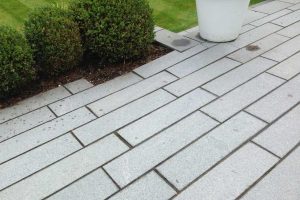
- Natural stone has longevity, a premium feel, and a quality that holds up over time and in photographs.
- Block paving is highly versatile, handles drainage well, and suits a wide range of property styles.
Each has a different cost and a different visual impact. There’s a fuller breakdown on the porcelain, natural stone, and block paving pages if you’re still deciding, and the four main factors when choosing a patio material are worth a read before committing.
The Cost of Getting It Wrong
A patio that looks impressive in year one but lifts, stains, or drains poorly by year three is a liability at the point of sale. Buyers and their surveyors will notice. The value case for a patio depends almost entirely on the quality of the installation: the surface, yes, but also the sub-base, the drainage, and the groundwork beneath it.


What Can Undermine a Patio's Value
A poorly planned patio can work against a sale rather than for it. Three common mistakes put buyers off:
- Impermeable materials without proper drainage. Since October 2008, The Ministry of Housing, Communities and Local Government (MHCLG) guidance on permeable surfacing has required permeable materials for front garden hard surfacing over 5 square metres, unless planning permission is obtained. A non-compliant installation is a problem a buyer’s solicitor will flag during conveyancing [3].
- A material that clashes with the property’s style. Modern porcelain can look out of place on a period cottage; traditional buff stone can date a contemporary one.
- A skimped sub-base. GOV.UK guidance puts a properly built patio at 200mm to 250mm deep, including 150mm of compacted sub-base over a permeable membrane. Skip it, and you get movement, cracking, and drainage issues within a few years.
The finish is only as good as what’s underneath it, whether the patio is at the front of the property, the back, or both.
Getting the drainage right from the start is what separates a patio that holds its value from one that doesn’t. This residential patio project in Dorchester shows how a full drainage transformation changes what’s possible on a difficult site.
So, Does a Patio Add Value?
Without a decent outdoor surface, a property’s potential stops at the back door. A well-chosen, well-built patio turns an underused garden into a space that earns its square footage and gives buyers one fewer reason to negotiate down. The return isn’t guaranteed, but a patio laid properly, with the right material for the setting and correct groundwork beneath it, will still be performing in ten years.
Fletchamoore has been designing and installing patios across Dorset since the 1960s, working on residential and commercial projects throughout Bournemouth, Poole, Wimborne, Ringwood, and the wider county. Our team are CIS-registered, carries £10m public liability insurance, and takes on projects of all sizes. If you want a patio that will still look right in five years’ time, it starts with an honest conversation about the material, the groundwork, and what the space actually needs.
Call 01202 624900 or get in touch to arrange a free quote.
External Sources
[1] Hillarys, UK Home Renovation Trends and Statistics 2025 (2025): https://www.hillarys.co.uk/static/home-renovation-statistics/
[2] Checkatrade, How to Add Value to Your Home: 12 Home Improvements That Will Add the Most Value (2025): https://www.checkatrade.com/blog/how-to/add-value-to-your-home/
[3] GOV.UK, Ministry of Housing, Communities and Local Government (MHCLG), Permeable Surfacing of Front Gardens: Guidance (2009): https://www.gov.uk/government/publications/permeable-surfacing-of-front-gardens-guidance


